
Why Soot Blower Valves Leak: Common Causes, Inspection and Replacement
Soot blower valve leakage can result from damaged valve seats, worn stem packing, incorrect actuation or leaking connections. Learn how to distinguish internal from external leakage, identify possible causes and verify critical specifications before repair or replacement.
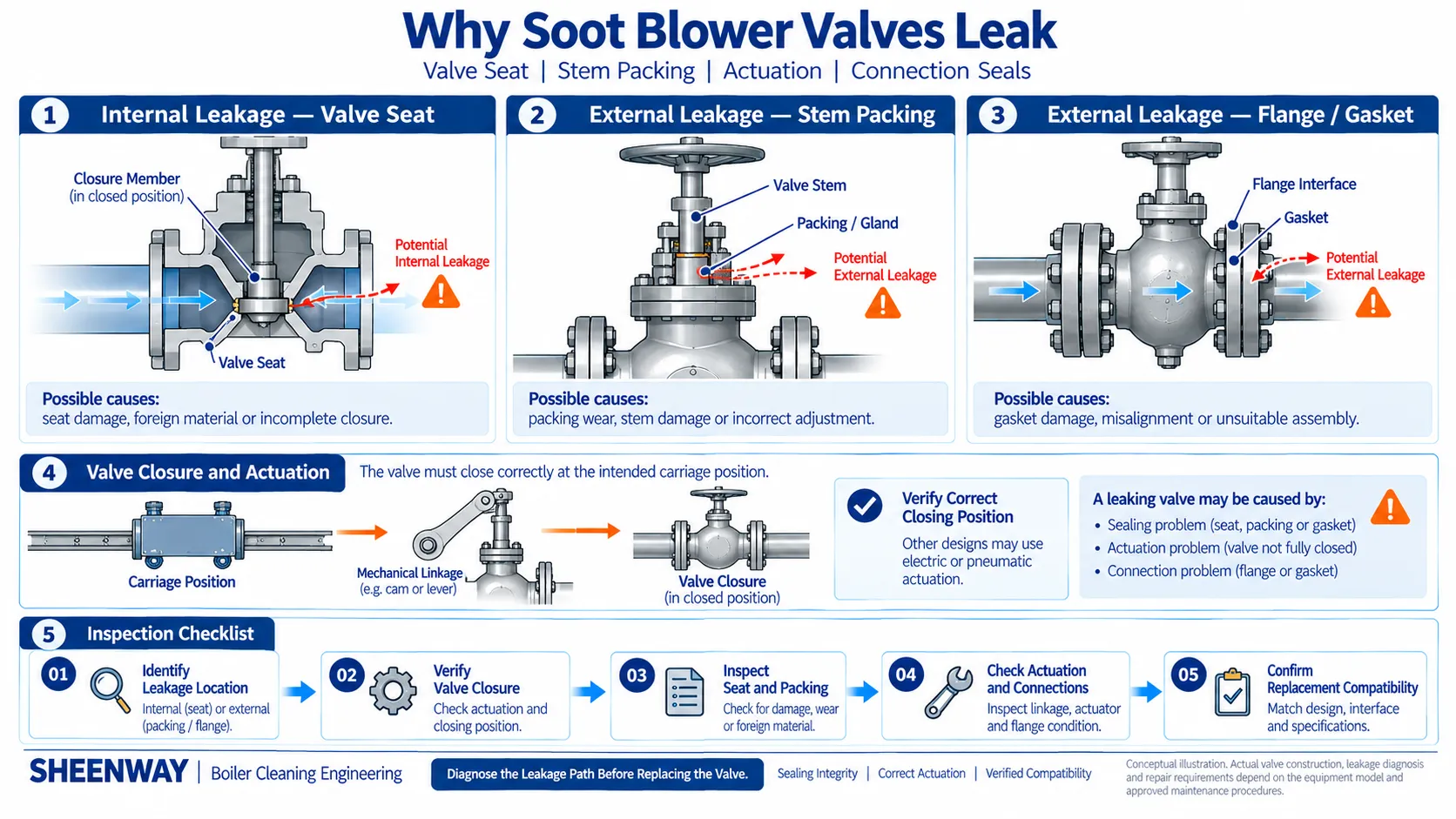
A soot blower valve controls the admission of steam or compressed air into the cleaning equipment. In many retractable soot blower designs, the valve opens at a specified stage of lance movement and closes when the cleaning operation is complete.
Its sealing performance is therefore important not only for controlling blowing-medium consumption, but also for maintaining the intended operating sequence.
A valve that leaks internally may allow steam to pass into the feed tube when the soot blower should be inactive. A valve that leaks externally may release steam around the valve stem, packing, flanges or other pressure-containing connections.
These two conditions have different failure mechanisms and require different inspection approaches.
Valve leakage may also be caused by improper actuation rather than damage to the sealing surfaces themselves.
Correct troubleshooting begins by identifying where the leakage occurs and whether the valve is actually reaching its intended closed position.
This article explains the major causes of soot blower valve leakage, practical inspection considerations and the technical information needed when ordering replacement components.
1. How Does a Soot Blower Valve Work?
In a typical retractable steam soot blower, the blowing-medium valve is located toward the rear of the equipment and controls medium flow to the feed tube and moving lance assembly.
Some conventional long retractable designs use a mechanically actuated lift or poppet valve.
In these systems, a trip mechanism associated with the moving carriage operates a cam and linkage, allowing the valve to open and close at the intended stages of travel.
Other soot blower configurations may use electrically or pneumatically actuated valves.
The precise valve architecture differs between manufacturers and equipment models.
A typical valve assembly may include:
- Valve body.
- Valve seat.
- Valve disc or closure member.
- Valve stem.
- Stem packing or sealing arrangement.
- Return or loading spring, where applicable.
- Mechanical linkage or actuator interface.
- Inlet and outlet connections.
Some valves also incorporate pressure-adjustment components.
However, these are general functional elements. Their exact construction should not be assumed without the relevant equipment documentation.
2. Internal Leakage vs External Leakage
Before deciding how to repair a leaking valve, the maintenance team should distinguish between internal and external leakage.
Internal Leakage
Internal leakage occurs when the valve is intended to be closed but the blowing medium continues to pass through the valve seat into the downstream equipment.
Possible indications include:
- Unexpected downstream warming during standby.
- Continued steam flow when the valve should be closed.
- Abnormal sound associated with flow through the valve.
- Unexpected pressure or temperature changes in the downstream system.
These observations require further verification because heat conduction, retained pressure or other operating conditions may produce similar indications.
External Leakage
External leakage occurs when the blowing medium escapes through a pressure-containing boundary.
Possible locations include:
- Valve stem packing.
- Valve-body joints.
- Flanged connections.
- Feed-tube connection gaskets.
- Other seals or damaged pressure-containing surfaces.
Visible steam, moisture or abnormal leakage noise may indicate an external problem.
The inspection must establish the actual source rather than assuming that all leakage near a valve originates from the valve seat.
3. Cause One: Valve Seat Erosion or Surface Damage
The valve seat and closure member form the primary sealing interface when the valve is closed.
Repeated operation under steam conditions can expose these surfaces to thermal and mechanical stresses.
Particles, wet steam, localized high-velocity flow or unsuitable operating conditions may contribute to sealing-surface damage.
Potential defects include:
- Localized erosion.
- Scoring or pitting.
- Uneven contact patterns.
- Distortion.
- Surface deposits or damage that prevent complete seating.
When the seat and closure member can no longer establish the required contact, internal leakage may occur.
The severity depends on the condition of the sealing surfaces and the operating conditions.
In some repairable designs, an approved lapping or refurbishment process may restore acceptable sealing.
Where the surfaces are severely damaged, replacement of the specified seat, closure component or larger valve assembly may be necessary.
The appropriate repair method depends on the original valve construction and allowable repair procedures.
4. Cause Two: Worn or Incorrectly Adjusted Stem Packing
Stem packing limits the escape of the blowing medium along the valve stem.
Over time, packing may deteriorate through thermal cycling, wear, aging or improper compression.
Leakage around the stem may indicate that the packing no longer provides the required sealing performance.
Possible contributing factors include:
- Packing wear.
- Incorrect packing material.
- Improper packing installation.
- Stem surface damage.
- Misalignment.
- Incorrect gland compression.
Excessive tightening is not necessarily the correct solution.
Overcompressed packing may increase valve-stem friction and interfere with proper valve movement or return.
This is especially important in mechanically operated valves where the closure mechanism relies on the valve stem moving freely.
Packing adjustment and replacement must follow the specific manufacturer's approved maintenance procedure.
Personnel must not loosen or dismantle pressurized packing assemblies.
5. Cause Three: Incorrect Mechanical Valve Actuation
In some long retractable soot blowers, the valve is opened and closed through the carriage-driven trip and cam mechanism.
This means that valve operation depends on correct interaction between the carriage position and mechanical linkage.
Potential problems include:
- Incorrect trip position.
- Misadjusted linkage.
- Worn cam surfaces.
- Binding components.
- Damaged connecting parts.
- Incomplete mechanical return.
If the mechanism prevents the valve from reaching its intended closed position, steam may continue to pass even when the seat and disc are not severely worn.
This condition can be mistaken for a damaged valve seat.
Before dismantling a valve, maintenance personnel should review whether its actuation mechanism is operating correctly.
After replacing a carriage or repairing the operating linkage, the valve actuation relationship may need to be verified again.
The actual adjustment method must follow the relevant equipment documentation.
6. Cause Four: Stem Binding or Incomplete Valve Closure
A valve may fail to close completely because the valve stem or associated operating components cannot move freely.
Potential causes include:
- Stem deformation.
- Corrosion.
- Excessive packing friction.
- Incorrect alignment.
- Contamination.
- Damaged guiding surfaces.
- Problems with the return mechanism.
This condition may produce internal leakage even when the valve sealing surfaces remain relatively serviceable.
For a spring-assisted closure arrangement, the spring and its supporting components may also require inspection if the valve does not return correctly.
A maintenance investigation should therefore consider the complete closure mechanism.
Replacing only the seat may not correct a valve that is mechanically prevented from closing.
7. Cause Five: Foreign Material at the Valve Seat
Deposits or foreign particles lodged between the closure member and valve seat can prevent proper sealing.
Possible sources include debris from piping work, corrosion products or other contamination within the steam system.
Foreign material may produce an intermittent leakage condition.
However, it may also damage the seat if the valve continues to operate under unsuitable conditions.
If contamination is suspected, the investigation should consider the condition of the upstream piping and the relevant steam-system maintenance history.
Valve inspection and cleaning must be performed only after proper isolation, depressurization and confirmation that the equipment is safe to work on.
8. Cause Six: Flange, Gasket or Connection Leakage
Not every apparent valve leak originates inside the valve.
External steam leakage may occur at the connections between the soot blower valve, supply piping, companion flange or feed tube.
Possible causes include:
- Gasket deterioration.
- Damaged sealing surfaces.
- Incorrect assembly.
- Flange misalignment.
- Unsuitable gasket material.
- Thermal movement or mechanical loading.
A connection leak requires a different corrective action from a valve-seat leak.
For example, replacing the valve disc will not repair a damaged flange gasket.
The inspection should identify the precise leakage boundary and confirm the relevant connection requirements before repair.
9. Common Symptoms and Diagnostic Starting Points
| Observed Condition | Possible Causes | Initial Investigation |
|---|---|---|
| Steam appears to pass downstream while closed | Seat damage, debris or incomplete closure | Verify actual flow and valve closure |
| Steam escapes around valve stem | Packing wear, stem damage or incorrect compression | Inspect packing and stem condition |
| Steam escapes near flange | Gasket or connection defect | Identify the leaking joint |
| Valve closes late | Incorrect mechanical timing or actuator issue | Check approved actuation sequence |
| Valve does not fully return | Binding, packing friction or return mechanism issue | Inspect movement and closure components |
| Leakage appears after maintenance | Incorrect assembly or adjustment | Review work performed and original configuration |
| Repeated seat damage | Steam conditions, contamination or closure problems | Review upstream system and operating history |
| Poor cleaning-medium delivery | Valve opening, pressure regulation or supply issue | Confirm the actual flow path and operating conditions |
These symptoms provide diagnostic starting points rather than definitive fault identification.
The maintenance team should use field observations, operating records and verified equipment information to determine the actual cause.
10. Can Poor Steam Quality Contribute to Valve Damage?
Steam quality and piping condition can influence the service life of steam-system components.
Condensate carryover, inadequate warm-up and poorly managed drainage may create unfavorable operating conditions.
Depending on the circumstances, liquid droplets or transient flow conditions can contribute to erosion and mechanical stress.
However, discovering valve-seat damage does not prove that condensate caused it.
Other mechanisms, such as foreign particles, thermal distortion, incorrect closure or ordinary service wear, may be involved.
For this reason, repeated valve leakage should prompt a review of both the valve and the surrounding steam system where appropriate.
Drainage, pressure control, valve timing and piping condition are related aspects of soot blowing reliability.
11. Repair, Rebuild or Replace the Valve?
A leaking valve does not automatically require complete replacement.
The decision should be based on the condition of the components and the repair options approved for the original design.
Packing Replacement
May be appropriate when the problem is localized to an otherwise serviceable stem-sealing arrangement.
Seat or Disc Refurbishment
May be appropriate where the original construction and approved repair procedure permit restoration of the sealing surfaces.
Linkage Repair or Adjustment
May be appropriate when the valve cannot complete its intended movement because of a mechanical actuation issue.
Complete Valve Replacement
May be necessary when significant damage affects the pressure-containing body, sealing geometry, structural integrity or other critical components.
Where pressure-boundary damage is suspected, qualified engineering assessment is necessary.
A valve should not be returned to service solely because an adjustment appears to stop visible leakage.
The repaired assembly must satisfy the applicable inspection and functional requirements.
12. What Should Be Verified Before Ordering a Replacement Valve?
When purchasing a replacement soot blower valve, the original equipment model and a general nominal valve size are not enough.
The following information is useful.
| Technical Information | Purpose |
|---|---|
| Original manufacturer and soot blower model | Identify the equipment family |
| Valve model and original part number | Identify the intended assembly |
| Valve type and actuation method | Confirm mechanical or actuator compatibility |
| Nominal size and connection dimensions | Verify piping interfaces |
| Pressure class and design conditions | Confirm service suitability |
| Body material and material standard | Verify mechanical and thermal requirements |
| Seat and disc materials | Confirm sealing-surface requirements |
| Stem and packing arrangement | Verify sealing and maintenance compatibility |
| Inlet and outlet orientation | Confirm installation configuration |
| Valve-opening and closing relationship | Confirm operational compatibility |
| Relevant drawings, measurements or sample | Support dimensional verification |
| Required inspection and documentation | Establish acceptance requirements |
For compatible replacement projects, the complete valve configuration should be compared against the verified original equipment requirements.
For example, a specified nominal size or pressure class does not establish equivalence of body geometry, connection details, internal trim or operating linkage.
13. OEM-Compatible Soot Blower Valve Replacement
Replacement valves may be manufactured to match an existing original-equipment configuration, provided the required technical specification is established.
SHEENWAY supports OEM-compatible soot blower spare-parts manufacturing, including replacement components for Clyde Bergemann and Diamond Power equipment.
For one-to-one replacement projects, relevant original dimensions, materials, mechanical interfaces and operating requirements should be verified.
Where an original material is unavailable or a proposed alternative is being considered, the material substitution should be evaluated separately.
A general similarity between two alloy designations does not automatically establish equivalence for every pressure-containing application.
The replacement specification must consider the applicable material standard, design conditions and project approval requirements.
One-to-one manufacturing capability means matching the verified original requirements, not treating every valve with a similar external appearance as interchangeable.
14. Inspection and Commissioning After Repair
After repair or replacement, the valve must be inspected before normal soot blowing resumes.
Depending on the design and approved procedures, verification may include:
- Material and component identification.
- Correct installation and connection orientation.
- Packing and gasket condition.
- Valve-stem movement.
- Seat closure and leakage acceptance.
- Mechanical linkage or actuator operation.
- Relationship between valve timing and lance movement.
- Appropriate pressure-boundary inspection or testing.
- Verification of relevant operating and control functions.
For mechanically operated valves, checking the carriage-to-valve relationship is particularly important.
For actuated valves, the relevant commands and feedback signals may also require verification.
Any leakage test, pressure test or adjustment must follow the approved maintenance and commissioning procedure.
Electrical and steam-energy isolation requirements must be observed throughout maintenance.
Conclusion
Soot blower valve leakage can originate from several different mechanisms.
Valve-seat erosion, damaged packing, incorrect actuation, stem binding, foreign material and connection defects may produce different forms of leakage.
The most important first step is to establish whether the problem is internal leakage, external leakage or incomplete valve closure.
A systematic investigation should consider the sealing surfaces, stem and packing, actuation mechanism and surrounding steam-system conditions.
For replacement projects, compatibility requires more than a matching nominal size.
The body material, pressure class, connections, sealing components and operating mechanism must match the approved requirements of the installed equipment.
Reliable soot blower valve performance depends on correct sealing, proper valve movement, suitable steam conditions and verified mechanical compatibility.
SHEENWAY provides technical support and customized manufacturing for compatible soot blower valves and spare parts based on verified original equipment specifications.
Customers can provide the original equipment model, valve part number, material requirements, relevant dimensions and available technical reference information for engineering review.
More from Sheenway
Continue Reading
Soot Blower Commissioning Checklist: From Cold Tests to Hot Operation
Commissioning a soot blowing system requires more than checking motor operation. This guide covers pre-start inspection, mechanical alignment, steam piping, drainage, electrical controls, cold functional testing, hot commissioning and final acceptance for reliable boiler soot blower operation.
Read articleSoot Blower Steam Piping Thermal Expansion: Supports, Flexibility and Connection Loads
Thermal expansion in soot blower steam piping can impose unintended loads on valves, flanges and equipment connections. This guide explains pipe flexibility, anchors, guides, supports, expansion compensation and drainage considerations for reliable boiler soot blowing systems.
Read articleSoot Blower Steam Consumption and Header Sizing: What Engineers Should Verify
Steam soot blowing systems must supply the required pressure and mass flow to each operating blower. This guide explains how individual steam consumption, simultaneous demand, header sizing, pressure drop, drainage and control sequencing affect steam supply system design and retrofit decisions.
Read article