
Soot Blower Commissioning Checklist: From Cold Tests to Hot Operation
Commissioning a soot blowing system requires more than checking motor operation. This guide covers pre-start inspection, mechanical alignment, steam piping, drainage, electrical controls, cold functional testing, hot commissioning and final acceptance for reliable boiler soot blower operation.
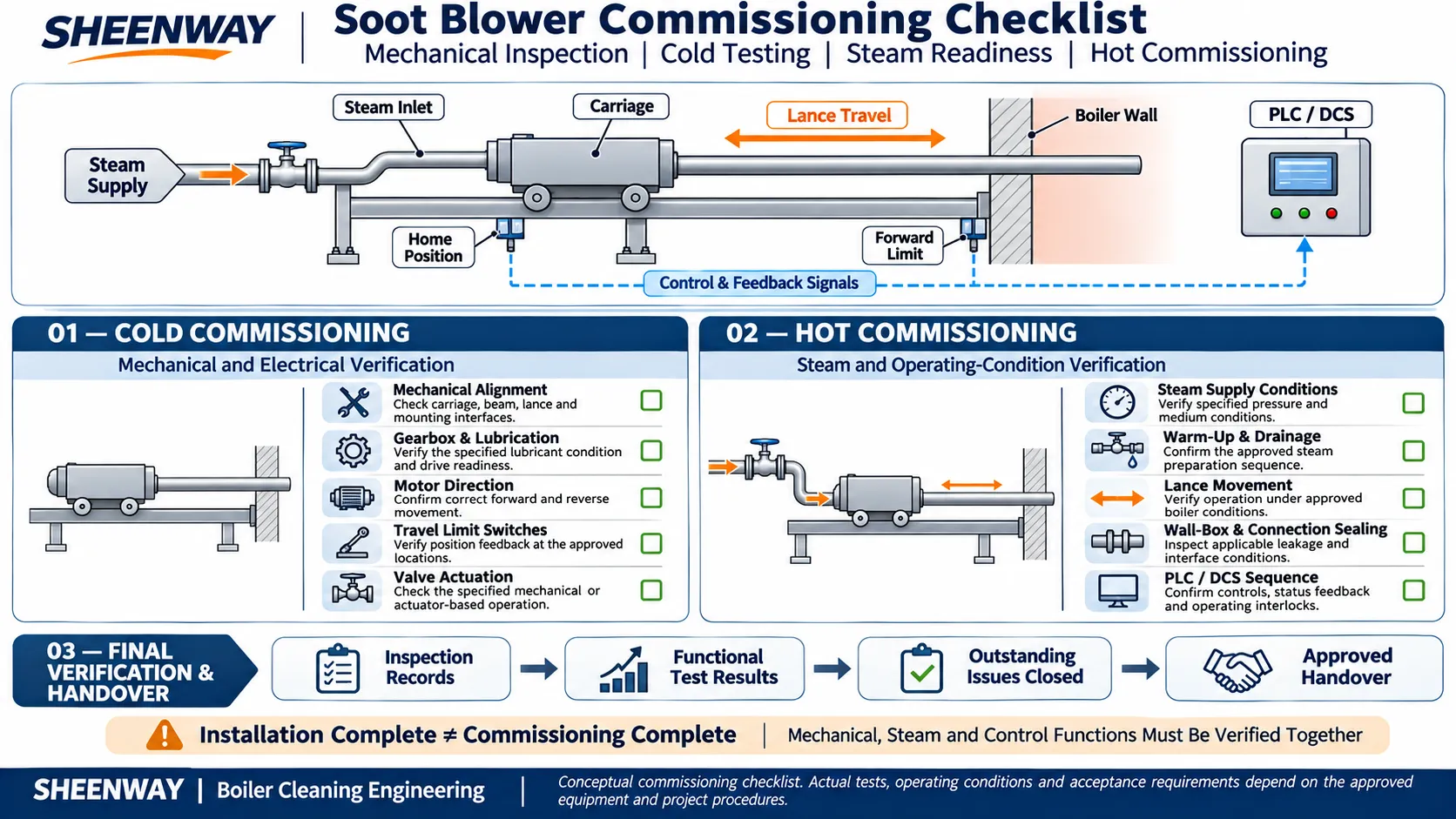
Installing a soot blower does not automatically mean that the equipment is ready for operation.
A retractable soot blower may be correctly mounted on its supporting structure but still have an incorrect motor rotation direction, misadjusted travel-limit switches, excessive sealing friction or an unsuitable blowing-medium supply.
Similarly, a properly functioning individual soot blower may experience problems when connected to a steam distribution system with inadequate drainage, unstable pressure regulation or incorrect control sequencing.
Commissioning is the process of checking that these individual components and systems operate together according to the approved engineering requirements.
For industrial boilers, this usually involves a combination of installation inspection, cold functional testing, steam-system preparation, hot commissioning and acceptance verification.
Successful soot blower commissioning requires confirmation of mechanical movement, steam conditions, valve timing, position feedback, control interlocks and the complete operating sequence.
This guide provides a practical engineering checklist for new installations, replacement soot blowers and boiler cleaning system retrofits.
1. What Is the Difference Between Installation, Commissioning and Acceptance?
These activities are related, but they do not represent the same stage of a project.
Installation
Installation involves positioning and securing the equipment, connecting mechanical interfaces, completing piping and electrical work, and confirming that the assembled system corresponds to approved documentation.
Cold Commissioning
Cold commissioning evaluates specified mechanical, electrical and control functions without normal steam soot blowing under boiler operating conditions.
Hot Commissioning
Hot commissioning evaluates the system under controlled, approved operating conditions with the necessary blowing medium and boiler conditions available.
Performance Verification and Acceptance
Acceptance involves comparing the completed system with the agreed technical specifications and documenting the required inspection and test results.
A successful motor rotation test is not proof that steam delivery, valve operation, nozzle performance and control integration have all been verified.
The commissioning plan must define the scope and acceptance criteria for each stage.
2. Confirm Engineering Documents Before Testing
The first commissioning activity should be a review of the approved project documentation.
Depending on the installation, important documents may include:
- Soot blower equipment list and identification tags.
- Approved equipment datasheets.
- Installation and interface drawings.
- Steam piping drawings and relevant P&IDs.
- Electrical schematics.
- PLC/DCS input and output lists.
- Control philosophy and sequence descriptions.
- Instrument and valve specifications.
- Applicable inspection and testing procedures.
- Equipment manuals and maintenance instructions.
The review should establish which equipment configuration has actually been installed.
This is especially important for replacement projects.
An existing boiler may contain modified support arrangements, different equipment generations or control interfaces that no longer exactly match historical documentation.
Any unresolved discrepancy affecting safe operation should be clarified before functional testing.
3. Mechanical Installation: What Should Be Checked?
A retractable soot blower requires correct alignment between the carriage, supporting beam, lance tube, front support and boiler-wall interface.
Mechanical inspection may include:
Carriage and Drive Assembly
Confirm that the carriage is correctly installed and that the guiding and transmission components correspond to the approved design.
Gear and Rack Engagement
Where rack-and-pinion travel is used, verify the required engagement and alignment.
Lance Tube
Inspect the lance for visible damage, deformation and unsuitable contact with surrounding components.
Front Support
Check whether the lance is correctly supported throughout its intended movement.
Wall Box and Boiler Penetration
Confirm that the installation permits the required lance travel and maintains the designed sealing interface.
Mounting and Clearance
Check for interference with structural members, piping, cables or nearby equipment.
Installation problems can create additional mechanical loading even when the motor and gearbox are functioning normally.
The equipment should not be forced through a resistant section to complete an initial movement test.
4. Gearbox Lubrication and Drive Readiness
Before operating the soot blower drive, the maintenance team should confirm the lubrication condition of the relevant gearbox, bearings and transmission components.
Important questions include:
- Is the correct lubricant specified?
- Is the gearbox supplied prefilled or requiring filling?
- Is the lubricant level or quantity appropriate?
- Are there visible leaks?
- Are the carriage guides and other lubrication points in the required condition?
- Is the motor and mechanical transmission ready for testing?
Lubrication requirements vary between manufacturers and models.
Some legacy retractable soot blower manuals specify that the gearbox is shipped without oil and must be filled before trial operation.
Other assemblies may be supplied under different conditions.
Therefore, the lubrication state must be checked against the documentation for the actual equipment.
Never assume that a replacement gearbox is ready to run solely because it has been installed.
5. Steam Piping and Pressure-System Readiness
The steam supply system should be checked independently before the soot blowers are admitted to hot operation.
Depending on the project, the piping review should cover:
- Completion of required pressure-system inspection and testing.
- Completion of approved cleaning or flushing activities.
- Verification of installed valves and equipment.
- Pipe routing and support arrangement.
- Thermal expansion compensation.
- Connection loads at soot blower valves.
- Insulation and drainage provisions.
- Pressure and temperature instrumentation.
- Actual steam-source availability.
Construction debris is a particular concern.
Metal particles, weld residue and other contamination left inside the piping system can damage valves, strainers or other downstream components.
The approved cleaning procedure should prevent debris from entering sensitive soot blower assemblies.
Pressure tests and flushing operations must follow the applicable piping design, codes and plant procedures.
No universal hydrostatic test pressure or flushing method should be applied to every soot blowing system.
6. Electrical and Instrumentation Checks
Electrical commissioning should establish that the installed connections and control devices correspond to the approved electrical design.
Typical checks may include:
| Inspection Item | Verification Objective |
|---|---|
| Motor nameplate | Confirm voltage, frequency and other required ratings |
| Motor connections | Confirm installation against the approved wiring diagram |
| Forward/reverse control | Verify the intended direction of movement |
| Motor protection | Confirm the required protection and status indication |
| Home-position switch | Confirm the correct standby-position signal |
| Forward-limit switch | Confirm the intended travel-position signal |
| Local controls | Confirm operating authority and correct commands |
| PLC input/output | Confirm required signals are assigned correctly |
| DCS interface | Verify the relevant commands, feedback and alarms |
The complete signal path should be checked where required, rather than relying only on an indication displayed on the operator screen.
For example, a home-position signal should correspond to the actual mechanical position of the equipment.
Any test involving energization or movement must be performed under the approved commissioning and electrical safety procedures.
7. Cold Commissioning: Verify Movement Before Steam Blowing
Cold commissioning is intended to identify mechanical and control problems before the equipment is exposed to normal blowing conditions.
For a conventional long retractable soot blower, relevant checks may include:
Motor Direction
Confirm that forward and reverse commands produce the required movement.
Carriage Movement
Observe whether the carriage follows the intended travel path without abnormal binding.
Limit Switches
Check that the applicable position-detection devices respond at their approved positions.
Lance Support
Verify that lance movement does not create abnormal contact at the front support or boiler-wall interface.
Drive Condition
Review abnormal noise, vibration and motor-current behavior where appropriate.
Return Position
Confirm that the lance returns to its specified standby position.
Manual movement or special maintenance-drive functions should only be used when specifically permitted by the equipment instructions.
Cold testing must not introduce an unapproved lance movement into a boiler containing hazardous gases, high temperatures or other uncontrolled conditions.
A successful cold test confirms selected functions under the tested conditions; it does not replace hot commissioning.
8. Valve Actuation and Timing Verification
Blowing-medium valve operation must be coordinated with the soot blower movement.
However, different soot blower designs use different valve-actuation arrangements.
Some conventional long retractable soot blowers use a mechanically operated lift or poppet valve.
In these systems, a carriage-associated trip mechanism controls valve opening and closing.
Other designs use valves with electric or pneumatic actuators and may provide explicit valve-position feedback.
The commissioning review should establish:
- The actual valve-actuation method.
- The required opening and closing relationship.
- The interaction between valve operation and lance position.
- The condition of mechanical linkages, where installed.
- The correctness of actuator commands and feedback, where applicable.
- The intended closed state at the completion of the operating cycle.
A valve should not be assumed to operate correctly merely because the carriage travels through its full stroke.
Similarly, a valve that opens and closes during a local test may still require verification under the approved operating conditions.
9. Steam Warm-Up, Condensate Drainage and Pressure Regulation
Steam piping may contain condensate after installation, shutdown or a period of standby.
During initial warm-up, steam transfers heat to the cooler piping and additional condensation may occur.
If condensate is not adequately managed, liquid carryover and water hammer can create significant operating risks.
The commissioning procedure should therefore address the applicable steam preparation requirements.
These may include:
Controlled Warm-Up
Bring the steam system toward its operating condition using the approved sequence.
Condensate Drainage
Confirm that drainage equipment and discharge paths function as designed.
Pressure Regulation
Verify the relevant downstream pressure conditions when pressure-reducing equipment is installed.
Steam Temperature and Condition
Review available measurements and specified steam-quality requirements.
Operating Permissions
Confirm the conditions required before allowing individual blowers to operate.
A timer reaching its setting does not independently establish that all condensate has been removed.
Likewise, a satisfactory supply-header pressure does not prove that the required conditions are available at every soot blower valve.
The actual readiness criteria must be established by the approved project design.
10. Hot Commissioning: Verify the System Under Operating Conditions
Hot commissioning examines how the mechanical equipment, steam system and controls operate together under the specified boiler conditions.
Depending on the project, relevant checks may include:
- Steam pressure at the required monitoring locations.
- Actual blowing-medium admission and valve response.
- Proper lance extension and retraction.
- Travel-limit and standby-position confirmation.
- Abnormal vibration or mechanical contact.
- Leakage at applicable connections.
- Wall-box sealing and protective-air performance where provided.
- Drainage operation during the intended sequence.
- Control-system response during individual blower operation.
- Completion of the approved cleaning sequence.
Hot commissioning should be performed only when boiler operating conditions and the project procedures permit it.
The first live operation should be conducted as a controlled test, rather than immediately enabling an unrestricted automatic cleaning program.
Where several blowers share a steam header, the approved simultaneous-operation limits also need to be respected.
Test results should be compared with the specified acceptance criteria.
11. PLC/DCS Integration and Interlock Testing
For centrally controlled soot blowing systems, proper operation also depends on communication and control authority.
The system may use a dedicated PLC to execute equipment sequencing, while the plant DCS provides supervisory commands and status monitoring.
A commissioning checklist may include:
Control Modes
Confirm the intended relationship between local, HMI, automatic and DCS operation.
Command Authority
Verify that conflicting control sources cannot unintentionally issue incompatible drive commands.
Position Feedback
Check the relevant home, forward-limit and running signals.
Motor Protection
Verify the specified responses to motor-protection conditions.
Steam-System Permissives
Check the applicable supply and drainage readiness signals.
Alarm and Fault Handling
Confirm that alarms, interlocks and protective actions match the approved cause-and-effect requirements.
Communications
Confirm the correct mapping of required commands, status indications and alarms.
Not every system has the same interlocks or feedback instruments.
Fault simulation and protective-function testing must use approved methods and must not expose personnel or equipment to uncontrolled movement or hazardous steam conditions.
12. Emergency Retraction and Abnormal Conditions
A retractable soot blower that fails to return to its standby position may leave part of its lance exposed to the boiler's hot gas path.
Depending on the equipment and operating conditions, this may create additional thermal or mechanical risks.
However, not every fault should produce an identical automatic response.
For example, a loss of position feedback is different from a mechanically jammed carriage.
Repeatedly energizing a jammed mechanism may worsen the damage.
Some soot blower designs have model-specific emergency or manual retraction provisions.
Their existence, control logic and safe use must be verified from the actual equipment documentation.
Commissioning must confirm the approved abnormal-condition response without assuming that every soot blower supports the same emergency recovery procedure.
Uncontrolled bypassing of limit switches or motor protection must not be used to complete commissioning.
13. What Should Be Recorded for Final Acceptance?
The commissioning process should produce an inspectable record showing that the required tests were completed and any outstanding issues were identified.
A practical acceptance matrix may include:
| Verification Area | Evidence or Record |
|---|---|
| Equipment identification | Verified model, tag and installed configuration |
| Mechanical installation | Inspection and alignment records |
| Lubrication readiness | Model-specific lubrication confirmation |
| Steam piping | Required pressure-system and cleaning records |
| Electrical installation | Wiring and protection checks |
| Position signals | Limit-switch and feedback test records |
| Valve operation | Timing and actuation verification |
| Cold functional testing | Travel and return test results |
| Hot commissioning | Operating-condition and functional records |
| PLC/DCS integration | Signal and interlock test records |
| Outstanding issues | Corrective action and closure status |
| Handover | Approved documents and responsible-party acceptance |
The exact documentation package depends on the contract, equipment type and plant requirements.
A completed checklist is useful only when the underlying tests and acceptance criteria have actually been satisfied.
14. Common Commissioning Mistakes
Several recurring problems can be reduced through systematic preparation.
Assuming That Installation Equals Readiness
A correctly installed machine still requires the appropriate mechanical and control tests.
Testing Only the Motor
Normal motor rotation does not establish correct valve timing, sealing or steam-supply performance.
Ignoring the Piping System
A functioning blower can still experience unsuitable steam conditions because of poor drainage or excessive pressure loss.
Using Default Settings Without Verification
Control timing and pressure settings from another machine or older project may not be applicable.
Treating Every Alarm as a Component Failure
A missing position signal can result from field wiring, switch adjustment, control logic or actual mechanical movement.
Beginning Full Automatic Operation Too Early
The required individual and system-level checks should be completed before normal sequence operation.
A structured commissioning plan helps identify these problems before they develop into recurring maintenance issues.
15. Commissioning During Soot Blower Retrofit Projects
Retrofit projects introduce additional considerations because new equipment must work with an existing installation.
The review may need to cover:
- Original and replacement mounting interfaces.
- Existing boiler-wall openings.
- Steam branch piping and valve connections.
- Existing pressure regulation and drainage.
- Motor and power-supply compatibility.
- Position-switch arrangements.
- PLC/DCS signal mapping.
- Original operating sequence.
- Actual mechanical clearances.
- Available maintenance access.
SHEENWAY's documented multi-boiler retrofit projects include both cold and hot commissioning after equipment installation.
In one three-boiler modernization project involving 150 soot blowers, commissioning covered mechanical travel, valve operation, limit-switch feedback, steam conditions and control-system functions.
The project illustrates an important principle: the commissioning scope should follow the complete soot blowing system, not only the replaced mechanical equipment.
Specific commissioning steps and acceptance values remain project-dependent.
Conclusion
Soot blower commissioning is a structured process of confirming that installed equipment can perform its required functions under the approved operating conditions.
Cold commissioning helps identify mechanical, electrical and position-control problems.
Steam-system preparation verifies the applicable piping, drainage and blowing-medium conditions.
Hot commissioning evaluates equipment movement, valve operation, sealing and control response under actual boiler conditions.
Final acceptance requires documented evidence that the agreed functional and technical requirements have been satisfied.
A reliable soot blowing installation is not established by successful motor operation alone. It is established by verified coordination between mechanical equipment, steam supply, control logic and operating conditions.
SHEENWAY supports soot blower installation, retrofit engineering, compatible replacement and commissioning-related technical verification.
For project review, customers can provide the equipment list, installation drawings, steam-system information, control documentation and required acceptance criteria.
More from Sheenway
Continue Reading
Soot Blower Steam Piping Thermal Expansion: Supports, Flexibility and Connection Loads
Thermal expansion in soot blower steam piping can impose unintended loads on valves, flanges and equipment connections. This guide explains pipe flexibility, anchors, guides, supports, expansion compensation and drainage considerations for reliable boiler soot blowing systems.
Read articleSoot Blower Steam Consumption and Header Sizing: What Engineers Should Verify
Steam soot blowing systems must supply the required pressure and mass flow to each operating blower. This guide explains how individual steam consumption, simultaneous demand, header sizing, pressure drop, drainage and control sequencing affect steam supply system design and retrofit decisions.
Read articlePositive-Pressure Boiler Wall Boxes: Sealing Air, Design and Common Problems
Positive-pressure boiler wall boxes help control flue-gas leakage around soot blower lance penetrations. This guide explains sealing-air principles, differences between positive- and negative-pressure arrangements, common faults and the engineering checks required for installation, maintenance and replacement.
Read article