
Replacement Soot Blower Carriage Assembly: 10 Compatibility Checks Before Ordering
Replacing a soot blower carriage assembly requires more than matching the original manufacturer and model. This guide explains ten essential compatibility checks, including mounting dimensions, gear-rack engagement, motor specifications, lance connections, sealing arrangements and control interfaces, to help engineers specify a reliable replacement.
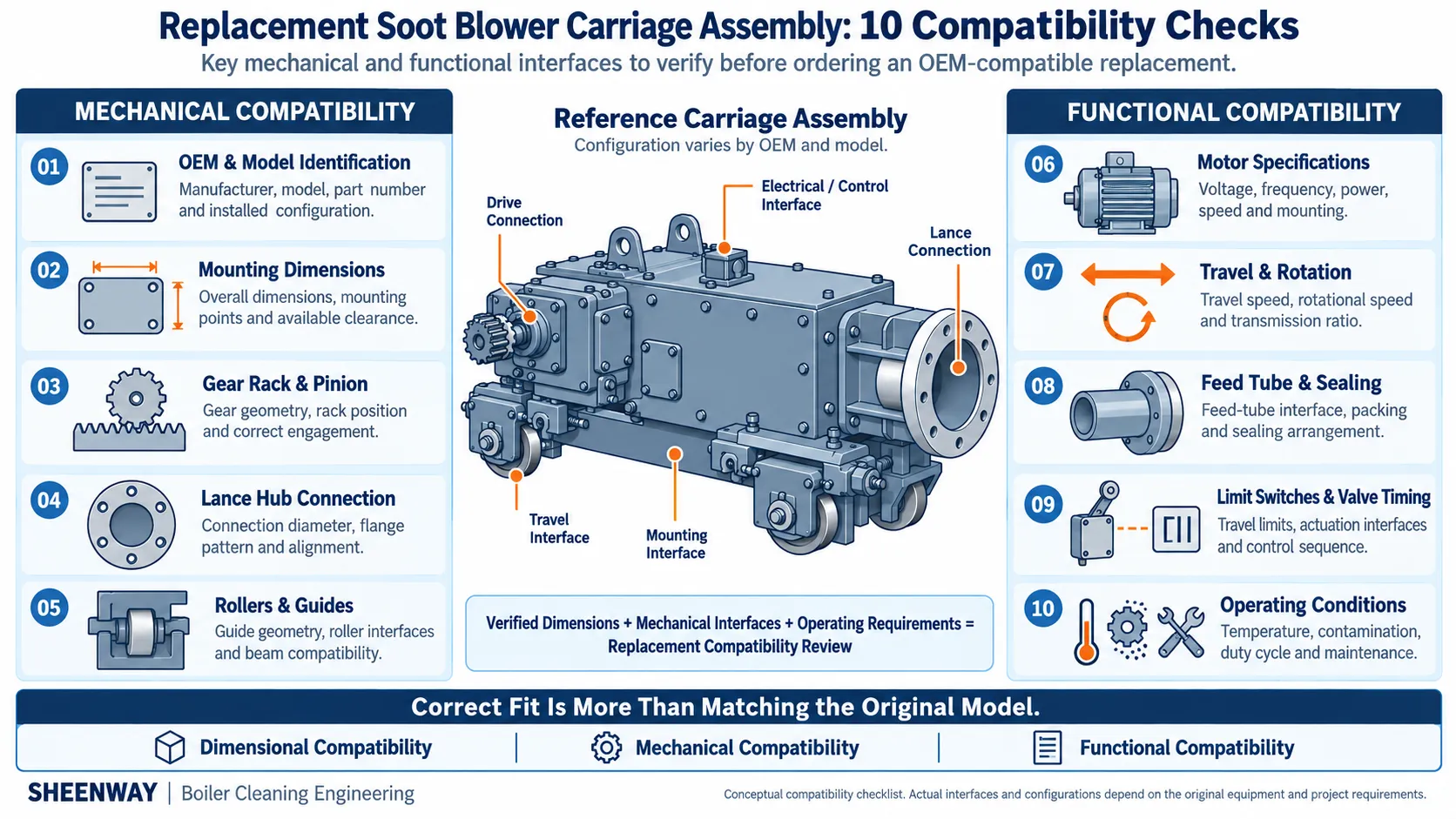
The carriage assembly is one of the most important mechanical components of a retractable soot blower.
It provides the movement required to insert and retract the lance tube and, depending on the design, drives lance rotation during the cleaning cycle.
When the carriage becomes worn or damaged, replacing the assembly may restore the required mechanical functions without replacing the entire soot blower.
However, ordering a replacement carriage is not as simple as identifying the original equipment manufacturer or selecting a gearbox with a similar appearance.
Two carriage assemblies may look nearly identical but differ in gear geometry, mounting dimensions, transmission ratios, lance connections, sealing arrangements or control interfaces.
These differences can affect installation, travel, rotation and operational reliability.
A replacement carriage must be compatible with the existing machine as a complete mechanical and functional system.
This guide explains ten essential engineering checks before ordering a replacement soot blower carriage assembly, particularly for existing long retractable soot blowers and cross-brand replacement projects.
1. Define the Replacement Scope: Gearbox or Complete Carriage?
Before requesting a quotation, the first step is to determine exactly which components need replacement.
A gearbox and a complete carriage assembly are not necessarily the same product.
Depending on the original design, a carriage assembly may include:
- Reduction gearbox and transmission components.
- Travelling gears or pinions.
- Supporting and guiding rollers.
- Drive shafts and bearings.
- Lance drive hub or connection assembly.
- Sealing or packing components.
- Associated mounting and mechanical operating parts.
Some designs allow the gearbox to be replaced separately from the lower housing or lance-connection components.
Other designs require a larger assembly to be removed or replaced.
For example, Clyde Industries documents a modular carriage design in which the gearbox and lower housing form separate serviceable units.
Babcock & Wilcox also offers carriage rebuild kits containing selected bearings, shafts, seals, rollers and other wear components.
These examples demonstrate an important procurement principle:
Confirm whether the required scope is an individual gearbox, a partial carriage assembly, a rebuild kit or a complete carriage assembly.
The quotation should identify precisely what is included and excluded.
2. Check One: Original Manufacturer, Model and Equipment Identification
The original manufacturer and model are the starting points for replacement identification.
Useful information includes:
Manufacturer
The original soot blower brand.
Equipment Model
The exact soot blower model or series.
Part Number
The original carriage or gearbox part number, where available.
Serial Number
The machine serial number or manufacturing reference.
Equipment Tag
The plant identification number associated with the installed machine.
These references help identify the original equipment family.
However, the model number alone may not describe the actual installed configuration.
A soot blower may have been modified, upgraded or repaired using components from a different design generation.
For this reason, the procurement review should establish both the original equipment specification and the current installed arrangement.
This is particularly important for replacement components intended for legacy equipment.
3. Check Two: Carriage Mounting and Overall Dimensions
The replacement carriage must physically fit the existing soot blower structure.
The dimensions requiring confirmation depend on the original design but may include:
- Overall length, width and height.
- Mounting hole positions and dimensions.
- Gearbox housing clearances.
- Supporting and guiding interfaces.
- Connection centerlines.
- Available movement and maintenance space.
The existing supporting beam may impose restrictions on the dimensions of the replacement.
Even a small difference in mounting geometry can cause interference or misalignment.
Where original drawings are available, they provide a useful starting point.
However, drawings should be checked against the installed equipment, especially if the machine has undergone previous modifications.
Dimensional compatibility is a necessary condition, but it does not establish complete functional compatibility.
4. Check Three: Gear Rack and Pinion Compatibility
Many retractable soot blowers use a rack-and-pinion mechanism to move the carriage along its supporting beam.
The pinion gear must engage correctly with the existing rack.
Important considerations may include:
Gear Tooth Geometry
The relevant module or pitch, tooth profile and other gear dimensions must correspond to the mating component.
Pinion Position
The pinion centerline must match the installed rack arrangement.
Rack Location
The position and spacing of the rack must be compatible with the carriage.
Engagement Across the Stroke
The gears must operate correctly throughout the required movement range.
Load Distribution
Where multiple drive gears are used, their engagement and relative positioning must be verified.
Babcock & Wilcox identifies gear-rack alignment and controlled gear engagement as important characteristics of its retractable soot blower designs.
A carriage that mounts successfully but does not engage the rack correctly can experience abnormal wear, uneven loading or restricted movement.
Therefore, the replacement gear geometry must be verified rather than estimated from external photographs alone.
5. Check Four: Motor and Electrical Specifications
The original motor specification is an essential part of replacement compatibility.
Relevant parameters include:
- Rated voltage.
- Frequency and phase.
- Rated power.
- Rated speed.
- Mounting arrangement.
- Shaft and coupling connection.
- Electrical protection requirements.
- Required direction of rotation.
A replacement motor with the same rated power is not necessarily interchangeable.
Differences in speed, shaft dimensions, mounting configuration or control requirements may affect the transmission system.
SHEENWAY's current SW-SLRG long retractable soot blower documentation lists a reference motor configuration of 1.1 kW, approximately 1,400 r/min, with a 380 V three-phase 50 Hz supply.
These values describe a reference configuration of the SW-SLRG series.
They must not be assumed applicable to every replacement carriage or existing OEM machine.
For cross-brand replacement projects, the installed motor and electrical system should be verified individually.
6. Check Five: Gearbox Ratio and Movement Characteristics
The gearbox converts motor input into the required output motion.
For a long retractable soot blower, the transmission must support the intended travelling movement and, where applicable, lance rotation.
Two gearboxes with matching external dimensions may produce different output speeds.
Important compatibility parameters include:
Travel Speed
The rate of axial movement along the supporting beam.
Lance Rotational Speed
The rotational movement required by the original cleaning arrangement.
Transmission Ratio
The relationship between motor input and the output movement.
Rotation Direction
The required direction of movement and rotation.
Operating Sequence
The relationship between forward travel, reverse travel and cleaning operation.
SHEENWAY's SW-SLRG documentation identifies reference travel speeds of 0.9–3.5 m/min and rotational speeds of 9–35 r/min.
These are product-family reference ranges, not universal replacement specifications.
The actual replacement must reproduce the required movement of the original equipment or an approved revised design.
Changing the movement characteristics without evaluation may alter the soot blower's cleaning pattern and operating sequence.
7. Check Six: Lance Hub and Mechanical Connection
The carriage must connect correctly to the lance assembly.
Depending on the original design, the interface may involve a hub, flange, keyed connection, threaded component or another mechanical arrangement.
The required review may include:
- Connection diameter.
- Flange or bolt pattern.
- Shaft or hub dimensions.
- Keyway configuration, where applicable.
- Axial positioning.
- Mechanical connection strength.
- Alignment with the lance tube.
A compatible housing does not automatically mean that the lance connection is compatible.
If the hub geometry is different, the lance may not mount correctly or may experience abnormal loading.
For this reason, original connection details should be confirmed through approved drawings, reliable measurements or representative original components.
8. Check Seven: Feed Tube, Packing and Sealing Interfaces
The feed tube supplies the blowing medium to the moving lance arrangement in many retractable soot blower designs.
The interface between the stationary supply components and the moving carriage may include dynamic sealing elements.
Depending on the original construction, the carriage assembly may incorporate:
- Packing chamber.
- Packing gland.
- Bushings.
- Sealing rings.
- Feed-tube support and alignment components.
The replacement must be compatible with the relevant feed-tube dimensions and sealing arrangement.
Incorrect packing or seal geometry can contribute to leakage, excessive friction or damage to the interacting surfaces.
For example, an unsuitable packing arrangement may increase the resistance experienced by the drive system.
However, not all carriage designs integrate the sealing components in the same way.
The replacement scope must therefore clarify whether the packing assembly is included, supplied separately or retained from the existing machine.
The operating pressure and temperature requirements also need to be considered.
9. Check Eight: Rollers, Guides and Supporting Beam
The carriage must move smoothly along its supporting structure.
Rollers and guide elements maintain the required travel path and provide mechanical support.
When selecting a replacement, important factors may include:
Roller Dimensions
Diameter, width and bearing interfaces.
Guide Arrangement
The location and geometry of the guiding surfaces.
Supporting Beam Compatibility
The relationship between the carriage and the original beam structure.
Clearance
The mechanical space available throughout the complete travel.
Loading
The forces transmitted through the supporting and driving components.
An unsuitable guide or roller arrangement can produce uneven movement or local mechanical interference.
Before installing a new carriage, the condition of the existing beam and guide surfaces should also be checked.
A replacement carriage cannot correct every defect in the surrounding installation.
10. Check Nine: Limit Switches and Valve-Actuation Interfaces
Mechanical replacement can affect the operating sequence of the soot blower.
For certain retractable designs, carriage movement is associated with mechanical or electrical mechanisms that control the opening and closing of the soot blower valve.
The carriage may also interact with forward and rear travel-limit switches.
Relevant checks include:
- Trip plates or mechanical actuating features.
- Limit-switch contact positions.
- Fully extended and fully retracted positions.
- Valve-opening and valve-closing sequence.
- Forward and reverse control.
- Motor protection and operating interlocks.
- Control-system signal compatibility.
The design must preserve the intended relationship between lance movement and blowing-medium admission.
A carriage that moves correctly but operates the valve or limit switches at the wrong position is not functionally compatible.
Any necessary adjustment or control modification must follow the approved project requirements.
11. Check Ten: Operating Environment and Maintenance Requirements
The operating environment also influences carriage selection.
Although the carriage is usually outside the main boiler gas path, it may still be affected by:
- Ambient temperature.
- Dust and contamination.
- Humidity and corrosion.
- Heat conducted from connected equipment.
- Vibration.
- Frequency of soot blowing cycles.
- Available maintenance access.
The gearbox, bearings, seals, motor and electrical components must be suitable for the actual installation.
Lubrication requirements should be verified against the exact gearbox design.
Some carriage designs use conventional lubricated gearboxes, while specialized designs may employ alternative bearing and lubrication arrangements.
It would therefore be incorrect to specify one lubricant or maintenance interval for all replacement carriages.
Operating conditions and maintenance requirements should be reviewed before finalizing the replacement.
12. SHEENWAY SW-SLRG and SW-SLRC: Why Drive Configuration Matters
SHEENWAY's current documentation distinguishes between two long retractable soot blower drive arrangements.
| Product Series | Documented Transmission Principle |
|---|---|
| SW-SLRG | Single-motor gear transmission |
| SW-SLRC | Single-motor gear-and-chain transmission |
This difference illustrates why model-family identification matters.
A replacement component intended for a gear-driven system should not automatically be treated as compatible with a gear-and-chain configuration.
The current SW-SLRG documentation also identifies two stroke variants: SW-SLRM and SW-SLRX.
However, stroke classification alone is insufficient to identify a replacement carriage.
The required drive characteristics, interface dimensions and installed configuration must still be confirmed.
Similarly, an original Diamond Power or Clyde Bergemann carriage may use a different mechanical architecture from SHEENWAY's standard product arrangement.
For a one-to-one replacement project, the manufacturing configuration must be established from the verified original equipment specification.
13. What Information Should Buyers Send with an Inquiry?
For international procurement, a clearly defined inquiry can reduce technical clarification and prevent incorrect component selection.
The following checklist is useful.
| Required Information | Purpose |
|---|---|
| Original manufacturer and model | Identify the equipment family |
| Carriage or gearbox part number | Identify the required component |
| Machine serial number or equipment tag | Confirm the installed unit |
| Photographs of the complete carriage | Review general construction |
| Photographs of mounting and connection details | Identify mechanical interfaces |
| Verified dimensions or reference drawings | Establish dimensional requirements |
| Gear rack and pinion information | Confirm transmission compatibility |
| Motor nameplate | Verify electrical and mechanical parameters |
| Lance connection details | Confirm hub and mounting geometry |
| Feed-tube and packing dimensions | Confirm sealing compatibility |
| Travel and rotation requirements | Confirm movement characteristics |
| Limit-switch and valve-actuation arrangement | Confirm operating-sequence compatibility |
| Required quantity and delivery destination | Support commercial quotation |
Where complete drawings are unavailable, clear photographs and accessible reference measurements can support the initial review.
If critical dimensions remain unknown, additional measurement or examination of a representative sample may be necessary before the final manufacturing specification is approved.
14. Complete Replacement, Partial Repair or Rebuild?
Replacing the entire carriage is not always necessary.
The correct scope depends on the condition of the original equipment.
Partial Repair
May be appropriate when damage is limited to identifiable serviceable components and the remaining assembly is in acceptable condition.
Gearbox Replacement
May be appropriate when the gearbox can be removed separately and the surrounding carriage structure remains suitable.
Carriage Rebuild
May be considered when the original housing and certain mechanical components can be reused after inspection, with relevant wear parts replaced.
Complete Carriage Replacement
May be appropriate when substantial damage, structural wear or equipment condition makes a larger replacement scope necessary.
Babcock & Wilcox offers rebuild kits for particular Diamond Power carriage models, while Clyde Industries provides both modular carriage components and complete replacement solutions.
These are examples of model-specific aftermarket approaches rather than universal repair methods.
Before deciding, the engineering team should also determine whether the original failure was caused by the carriage itself.
A misaligned rack, damaged supporting beam or unsuitable lance support may continue to cause problems after a new carriage is installed.
15. Replacement Verification and Commissioning
After receiving a replacement carriage, compatibility should be verified before the soot blower returns to service.
The inspection and commissioning process should follow the approved equipment instructions and plant safety requirements.
Depending on the design and replacement scope, checks may include:
- Confirmation of part identification and dimensions.
- Inspection of mounting surfaces and mechanical connections.
- Verification of rack and pinion engagement.
- Confirmation of gearbox lubrication condition.
- Inspection of carriage roller and guide alignment.
- Verification of lance-hub installation.
- Inspection of feed-tube sealing interfaces.
- Motor electrical checks.
- Forward and reverse travel verification.
- Limit-switch and valve-actuation checks.
- Controlled functional testing under the approved procedure.
A correct physical fit does not by itself demonstrate reliable operation.
The final acceptance should confirm that the replacement carriage provides the required mechanical movement and interacts correctly with the remaining equipment.
16. OEM-Compatible Replacement: What Does It Mean?
An OEM-compatible replacement is intended to reproduce the required form, fit and function of the specified original component.
For a carriage assembly, this involves more than matching a brand name.
The replacement should satisfy the applicable dimensional, mechanical, transmission, sealing and operating requirements.
SHEENWAY provides manufacturing and engineering support for compatible soot blower spare parts, including components used in Diamond Power and Clyde Bergemann equipment.
For verified one-to-one replacement projects, the manufacturing design is developed against the original equipment specification and confirmed interfaces.
However, one-to-one manufacturing capability does not mean that different OEM carriage versions are universally interchangeable.
Each replacement must match its intended equipment configuration.
Where the original design has been modified, the existing installation must be assessed before the final replacement specification is released.
This verification process helps reduce avoidable installation problems and supports reliable long-term operation.
Conclusion
A replacement soot blower carriage assembly must be specified as a functional mechanical component, not merely purchased as a gearbox with a similar appearance.
Correct compatibility depends on ten essential areas:
Original equipment identification, mounting dimensions, rack and pinion engagement, motor specifications, transmission characteristics, lance connection, feed-tube sealing, carriage guidance, control interfaces and operating conditions.
These factors are interconnected.
A carriage that fits the beam may still have an incorrect transmission ratio.
A gearbox that produces the required travel speed may still have an incompatible lance hub.
A mechanically suitable assembly may still fail to operate correctly if its limit-switch or valve-actuation arrangement is different.
Successful carriage replacement requires dimensional compatibility, mechanical compatibility and functional compatibility together.
SHEENWAY supports replacement soot blower carriage projects through equipment identification, technical comparison, dimensional verification and manufacturing based on the confirmed original specifications.
For a technical quotation, customers can provide the original model, part number, photographs, relevant dimensions and operating requirements.
The objective is to deliver a replacement that is correctly matched to the actual installed equipment.
More from Sheenway
Continue Reading
Soot Blower Commissioning Checklist: From Cold Tests to Hot Operation
Commissioning a soot blowing system requires more than checking motor operation. This guide covers pre-start inspection, mechanical alignment, steam piping, drainage, electrical controls, cold functional testing, hot commissioning and final acceptance for reliable boiler soot blower operation.
Read articleSoot Blower Steam Piping Thermal Expansion: Supports, Flexibility and Connection Loads
Thermal expansion in soot blower steam piping can impose unintended loads on valves, flanges and equipment connections. This guide explains pipe flexibility, anchors, guides, supports, expansion compensation and drainage considerations for reliable boiler soot blowing systems.
Read articleSoot Blower Steam Consumption and Header Sizing: What Engineers Should Verify
Steam soot blowing systems must supply the required pressure and mass flow to each operating blower. This guide explains how individual steam consumption, simultaneous demand, header sizing, pressure drop, drainage and control sequencing affect steam supply system design and retrofit decisions.
Read article