
How Does a Long Retractable Soot Blower Work? Applications, Operation and Selection
Long retractable soot blowers are widely used to clean superheater, reheater and economizer tube banks in industrial boilers. This guide explains how they work, why the lance both travels and rotates, and which engineering parameters must be considered during selection.
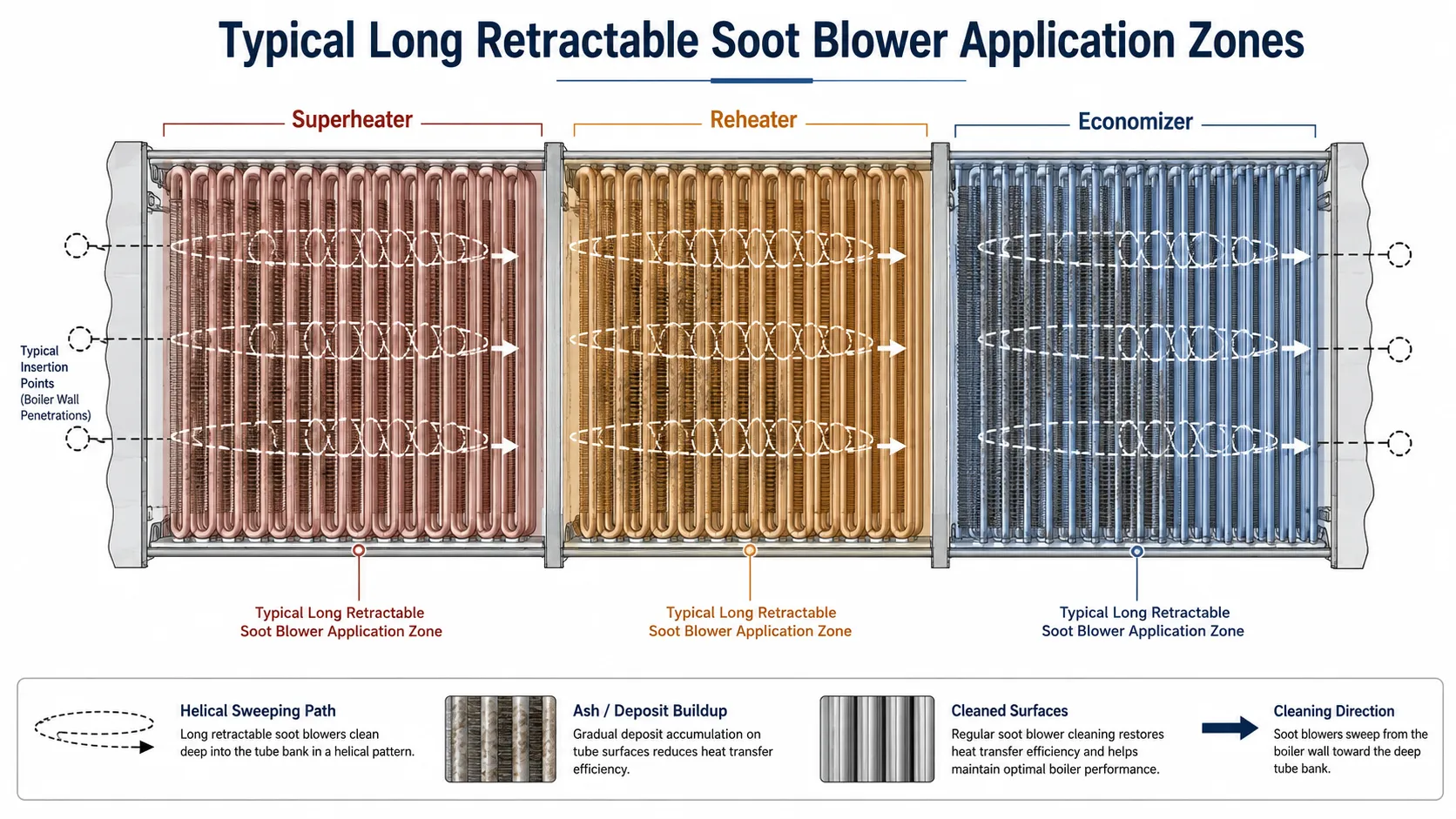
How Does a Long Retractable Soot Blower Work?
Ash deposition on boiler heating surfaces is not limited to the furnace. As flue gas moves through the convective sections of a boiler, fly ash and other deposits can accumulate on superheater, reheater and economizer tube banks.
These areas present a particular cleaning challenge. The heating surfaces may extend several meters into the boiler, while the spaces between tube banks can be narrow and difficult to reach from the boiler wall.
This is where the long retractable soot blower becomes particularly important.
Unlike a fixed cleaning device, a long retractable soot blower moves a lance tube deep into the boiler during the cleaning cycle. The lance simultaneously rotates while steam or compressed air is discharged through the nozzles, allowing the cleaning jets to cover a much larger area of the heating surface.
After the cleaning cycle is completed, the lance retracts from the boiler.
This combination of linear travel, rotation and controlled jet cleaning makes the long retractable soot blower one of the most widely used cleaning technologies for convective boiler heating surfaces.
Where Are Long Retractable Soot Blowers Used?
Long retractable soot blowers are primarily applied where heating surfaces are located deep inside the boiler gas path.
Typical applications include:
- Superheaters
- Reheaters
- Economizers
- Slag screens and other convective heating surfaces
- Furnace-top heating surfaces
- Certain tubular air-preheater sections
The exact application depends on boiler geometry, gas temperature, fuel characteristics and the nature of the deposits.
In superheater and reheater sections, for example, a soot blower must reach between large tube-bank areas while providing sufficient cleaning coverage without remaining permanently exposed to the high-temperature gas environment.
This is one of the key advantages of a retractable design: the lance enters the boiler when cleaning is required and returns to its standby position after the cycle.
The Basic Operating Principle
A long retractable soot blower performs several coordinated actions during a cleaning cycle.
1. The Lance Travels into the Boiler
At the beginning of the cycle, the carriage drives the lance tube from its standby position toward the target heating surface.
The required travel distance depends on the width and arrangement of the boiler section being cleaned.
In the SHEENWAY SW-SLRG Series, two stroke ranges are available:
- SW-SLRM: up to 7.60 m
- SW-SLRX: 7.65–13.70 m
The stroke should therefore be selected according to the actual boiler geometry rather than simply choosing the longest available configuration.
2. The Lance Rotates During Travel
Linear movement alone would create only a limited cleaning path.
For this reason, the lance also rotates during operation.
The combined forward or backward movement and rotation cause the nozzle jets to follow a helical cleaning path through the target area.
This allows the soot blower to distribute cleaning energy around the surrounding tube-bank surfaces instead of repeatedly directing the jet toward only one line.
For the SW-SLRG Series, the rotational speed can be configured within a range of 9–35 r/min, while the forward and backward travel speed is typically 0.9–3.5 m/min.
These values are not arbitrary. Travel speed and rotational speed affect the cleaning trajectory and the amount of time the jet acts on a particular region.
3. Steam or Compressed Air Is Discharged Through the Nozzles
The cleaning medium enters the soot blower and is discharged through nozzles located on the lance.
Steam is commonly used, while compressed air can also be used where the available system conditions make it appropriate.
The nozzle converts the pressure of the cleaning medium into a high-velocity jet.
That jet provides the mechanical energy required to loosen and remove deposits from the heating surface.
However, effective cleaning is not simply a matter of increasing pressure.
Nozzle diameter, medium pressure, flow rate, distance to the heating surface and deposit characteristics must work together as an engineering system.
For the SW-SLRG Series, available nozzle diameters are generally within the 12–32 mm range, with an approximate blowing radius of 2 m and a 360-degree blowing arrangement.
The final nozzle configuration is determined for the individual boiler application.
4. The Lance Retracts After Cleaning
When the cleaning cycle is complete, the lance returns to its external standby position.
This is particularly important in high-temperature boiler sections.
Keeping the lance outside the boiler when it is not operating reduces its continuous exposure to the hot flue-gas environment compared with a permanently installed internal lance.
The retractable configuration therefore combines deep cleaning access with a mechanical arrangement suited to demanding convective boiler sections.
Why Do Travel Speed and Rotational Speed Matter?
A long retractable soot blower does not clean a tube bank at a single point.
Its cleaning pattern is produced by the relationship between:
- lance travel speed,
- lance rotational speed,
- nozzle arrangement,
- nozzle diameter,
- blowing-medium pressure and flow,
- and the distance between the nozzle and the target surface.
If these variables are not coordinated correctly, cleaning coverage may not match the geometry of the tube bank.
This is why soot blower selection should not be reduced to a simple question such as:
“How long is the soot blower?”
Stroke is important, but it is only one part of the design.
Two soot blowers with the same mechanical travel may require very different nozzle arrangements and operating parameters when installed in boilers burning different fuels or operating at different gas temperatures.
Why Boiler and Ash Conditions Must Be Considered
One of the most important principles in soot blower engineering is that the cleaning system must be matched to the boiler operating environment.
For long retractable soot blowers, engineering calculations should consider factors including:
Flue-gas temperature
The temperature of the installation zone affects the operating environment of the lance tube and other internal components.
Fuel and ash characteristics
Different fuels produce deposits with different physical characteristics. Loose fly ash and more strongly bonded deposits do not necessarily require the same cleaning intensity.
Available blowing medium
Steam or compressed-air pressure and flow determine the energy available at the nozzle.
Heating-surface geometry
Tube spacing, bank depth and the distance from the lance to the heating surfaces influence the required cleaning trajectory.
Required stroke
The lance must reach the intended cleaning zone while fitting within the available external installation and maintenance space.
Nozzle configuration
The number, diameter and arrangement of nozzles must be selected according to the required cleaning coverage.
For this reason, parameters such as stroke, travel speed, rotational speed, nozzle quantity, nozzle diameter, medium pressure and flow should ultimately be determined according to the actual boiler and operating conditions.
Typical SW-SLRG Series Engineering Parameters
The following figures provide a general reference for the SHEENWAY SW-SLRG Series:
| Parameter | Typical Range / Configuration |
|---|---|
| Cleaning medium | Steam or compressed air |
| SW-SLRM stroke | Maximum 7.60 m |
| SW-SLRX stroke | 7.65–13.70 m |
| Forward / backward speed | 0.9–3.5 m/min |
| Rotational speed | 9–35 r/min |
| Nozzle diameter | 12–32 mm |
| Approximate blowing radius | Approx. 2 m |
| Blowing angle | 360° |
| Drive motor | 1.1 kW, approx. 1400 r/min |
These values should be treated as an engineering range rather than a universal configuration.
The final design depends on the boiler arrangement and operating data supplied for the specific project.
What Are the Main Components of a Long Retractable Soot Blower?
A complete long retractable soot blower is more than a lance tube and nozzle.
Typical major components include:
- Carriage and drive motor / reducer
- Soot blower valve
- Beam structure
- Boiler wall box
- Front lance support
- Inner tube
- Lance tube and nozzle assembly
- Electrical control and travel-limit system
- Optional helical phase-control mechanism
- Sealing arrangements for positive-pressure applications
Each component contributes to the controlled movement, medium supply, positioning and safe operation of the soot blower.
For retrofit projects, these mechanical interfaces are particularly important because the new equipment must match the boiler wall connection, structural support, available platform space and existing control system.
Long Retractable vs. Semi-Retractable Soot Blowers
A long retractable soot blower removes the lance from the boiler after cleaning.
A semi-retractable soot blower, by comparison, keeps part of the lance inside the boiler during standby.
Semi-retractable designs can therefore be useful in lower-temperature regions where installation space outside the boiler is limited.
The correct choice depends on the temperature of the cleaning area, required coverage, available platform space and boiler geometry.
For deep superheater and reheater tube banks exposed to relatively high gas temperatures, the fully retractable configuration remains an important solution because the lance can be withdrawn from the gas path after cleaning.
Selection Should Start With Boiler Data, Not a Model Number
A common mistake in industrial equipment purchasing is to begin with an existing model number and assume that another soot blower with a similar size will automatically provide equivalent performance.
For long retractable soot blowers, dimensional compatibility is only part of the engineering problem.
Before selecting or replacing the equipment, engineers should confirm at least:
- boiler section and heating-surface arrangement,
- required travel distance,
- flue-gas temperature,
- fuel and ash characteristics,
- steam or compressed-air conditions,
- nozzle arrangement,
- existing wall-box interface,
- structural support,
- electrical supply and control requirements,
- and available maintenance space.
A properly selected soot blower is therefore a result of matching the cleaning system to the boiler rather than simply matching one machine to another.
Conclusion
Long retractable soot blowers provide a practical way to clean heating surfaces located deep inside the convective sections of industrial boilers.
By combining lance travel, rotation and controlled high-velocity cleaning jets, they can cover extensive tube-bank areas in superheaters, reheaters, economizers and other boiler sections.
But effective performance depends on more than the soot blower itself.
Stroke, travel speed, rotational speed, nozzle configuration, blowing-medium conditions, fuel characteristics, ash properties and boiler geometry must all be considered together.
For new installations and retrofit projects, SHEENWAY SW-SLRG Series Long Retractable Soot Blowers can be engineered according to the boiler configuration and operating conditions, allowing the cleaning system to be matched to the actual application rather than relying on a fixed standard arrangement.