
Soot Blower Nozzle Design: Why Diameter, Pressure, Angle and Distance Matter
Soot blower performance depends on more than steam pressure. Nozzle diameter, jet direction, blowing distance, medium flow and soot blower movement all affect cleaning coverage and intensity. This article explains why nozzle design must be matched to the boiler heating surface and deposit conditions.
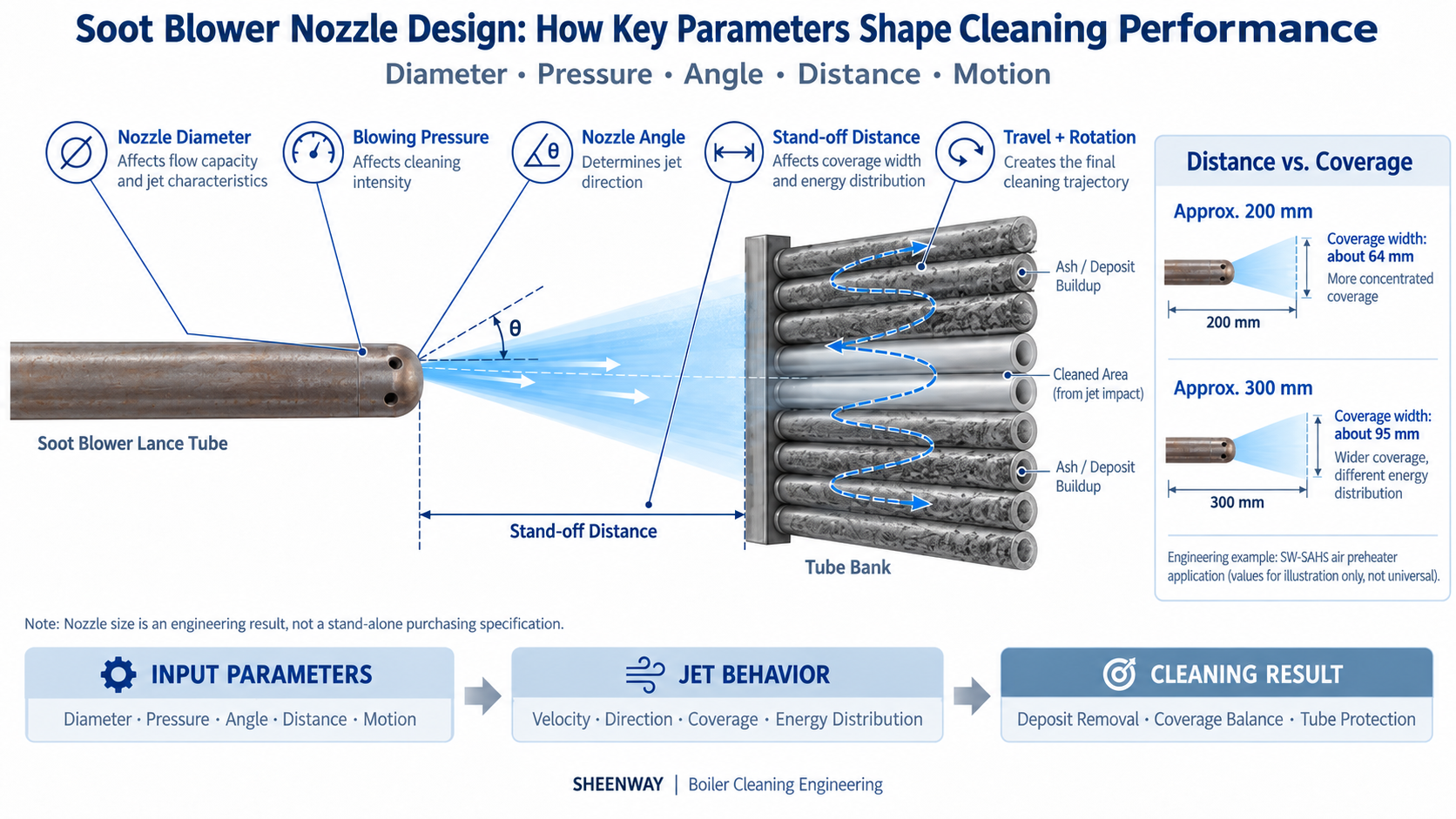
Soot Blower Nozzle Design: Why Diameter, Pressure, Angle and Distance Matter
When evaluating a steam soot blower, attention often goes first to the machine itself: stroke, lance length, motor, valve or installation dimensions.
However, the actual cleaning action takes place at a much smaller component—the soot blower nozzle.
The nozzle converts the pressure and flow of steam or compressed air into a high-velocity jet directed toward the deposit-covered surface. Its diameter, orientation and distance from the target all affect how cleaning energy is distributed.
For this reason, effective soot blowing is not simply a matter of applying the highest possible pressure.
A well-designed system must balance cleaning intensity, coverage, deposit characteristics and the geometry of the heating surface.
What Does a Soot Blower Nozzle Actually Do?
Steam or compressed air entering a soot blower contains pressure energy.
As the cleaning medium passes through the nozzle, that energy is converted into a high-velocity jet.
The jet travels across the space between the lance and the heating surface before interacting with ash, slag or other deposits.
The resulting cleaning effect depends on several variables acting together:
- nozzle diameter,
- blowing-medium pressure,
- medium flow,
- nozzle orientation,
- distance to the heating surface,
- soot blower travel and rotation,
- and the physical characteristics of the deposit.
Changing one of these parameters can affect the others.
That is why nozzle selection should be treated as part of the overall soot blowing system rather than as an isolated component decision.
1. Nozzle Diameter Affects Flow and Cleaning Energy
Nozzle diameter is one of the most obvious design variables.
A larger nozzle opening can allow more cleaning medium to pass through under a given system condition, while a smaller opening changes the relationship between pressure, flow and jet characteristics.
However, simply increasing nozzle diameter does not automatically improve cleaning.
The available steam or compressed-air supply must be able to support the required flow. The target surface must also be located within an effective cleaning range.
For example, SHEENWAY's SW-SLRG Series Long Retractable Soot Blowers uses nozzle diameters generally within a 12–32 mm engineering range.
This does not mean that every installation should use the largest nozzle.
The final nozzle quantity and diameter are selected according to the boiler gas temperature, fuel and ash characteristics, blowing-medium conditions and heating-surface arrangement.
In other words:
Nozzle size is an engineering result, not a stand-alone purchasing specification.
2. Higher Pressure Is Not Always Better
Steam pressure is another parameter that is often misunderstood.
Insufficient pressure may result in inadequate cleaning energy. Deposits remain on the heating surface, and the expected benefit of the soot blowing cycle is not achieved.
But excessive cleaning intensity is not necessarily desirable either.
A soot blower operates close to boiler tubes, catalyst elements, heat-transfer surfaces or air-preheater components. The objective is to remove deposits while avoiding unnecessary mechanical or thermal loading on the equipment being cleaned.
Different soot blower designs therefore operate with different pressure ranges and operating strategies.
For example, SHEENWAY furnace soot blower documentation specifies approximately 1.5 MPa blowing pressure for the SW-SFBA/SW-SFBB design, together with a single 25.4 mm nozzle and a defined cleaning radius.
This is a configuration for that particular equipment and application—not a universal pressure value for all soot blowers.
The appropriate pressure must ultimately be considered together with nozzle geometry, flow rate, cleaning distance and deposit strength.
3. Blowing Distance Changes the Effective Coverage
The distance between a nozzle and the target surface has a direct effect on the way the jet reaches that surface.
As the jet travels away from the nozzle, its coverage changes.
A useful example appears in the SHEENWAY SW-SAHS Air Preheater Soot Blower documentation.
For this design, the air or steam jet has a defined diffusion angle. When the nozzle is approximately 200 mm from the air-preheater sector plate, the stated coverage width is about 64 mm.
When that distance increases to approximately 300 mm, the coverage width increases to about 95 mm.
This demonstrates an important engineering principle:
Distance affects coverage.
But wider coverage should not automatically be interpreted as stronger cleaning.
As distance changes, the distribution of jet energy across the target area also changes.
The correct installation distance therefore depends on whether the design priority is concentrated cleaning intensity, wider coverage, or a balance between the two.
4. Nozzle Angle Determines Where the Jet Acts
Nozzle orientation determines the direction in which the cleaning medium reaches the target surface.
This becomes particularly important when the soot blower itself rotates or travels.
For example, the SHEENWAY furnace soot blower uses a single nozzle that advances into position and then performs rotary cleaning.
Its documentation specifies a 3° rear inclination angle for the nozzle.
The blowing arc, number of cleaning rotations and blowing pressure can also be adjusted according to deposit conditions and the requirements of the boiler section.
This illustrates why nozzle angle should not be considered independently.
The final cleaning trajectory is produced by the combination of:
nozzle direction + lance movement + rotation + operating time.
5. A Moving Soot Blower Creates a Cleaning Pattern
For a long retractable soot blower, the nozzle does not remain in one position.
The lance moves forward or backward while rotating.
As a result, the jet follows a moving cleaning trajectory through the tube-bank region.
For the SW-SLRG Series, the travel speed can be configured within approximately 0.9–3.5 m/min, while rotational speed is within approximately 9–35 r/min.
Combined with nozzle position and geometry, these movements determine how frequently and for how long different areas of the tube bank are exposed to the cleaning jet.
This is why two soot blowers with similar nozzle sizes may produce very different cleaning patterns if their travel and rotational settings are different.
6. Different Boiler Areas Require Different Nozzle Strategies
A furnace water wall, superheater tube bank, SCR catalyst and rotary air preheater do not present the same cleaning problem.
Their geometry, deposit characteristics and tolerance to cleaning impact are different.
A furnace soot blower may need to address relatively strong ash or slag deposits on water-wall surfaces.
A long retractable soot blower must distribute cleaning jets through deep superheater or reheater tube banks.
An air-preheater soot blower must coordinate its lance movement with the rotation of the air-preheater elements.
The SW-SAHS design, for example, uses linear lance movement while the rotary air preheater itself rotates. This produces several Archimedean spiral cleaning tracks, allowing multiple nozzles to progressively cover the heat-transfer surface.
The nozzle arrangement therefore has to follow the geometry of the equipment being cleaned.
Why “Same Nozzle Size” Does Not Mean “Same Performance”
When replacing soot blower parts, it may be tempting to compare nozzles only by physical diameter.
That can be misleading.
Two nozzles with the same nominal opening may operate under different:
- inlet pressures,
- steam conditions,
- flow rates,
- lance movements,
- stand-off distances,
- tube-bank geometries,
- and deposit conditions.
Therefore, dimensional similarity alone does not establish equivalent cleaning performance.
For retrofit and replacement projects, engineers should verify the operating conditions of the complete soot blowing system before changing nozzle configuration.
What Information Is Needed for Nozzle Selection?
Before determining nozzle quantity, diameter or arrangement, the following project information is typically important:
Boiler section
Is the soot blower cleaning a furnace wall, superheater, reheater, economizer, SCR, air preheater or another surface?
Heating-surface geometry
Tube spacing, bank depth and available nozzle-to-surface distance affect coverage.
Fuel and ash characteristics
Different deposits require different cleaning strategies.
Flue-gas temperature
The operating environment affects both equipment design and cleaning requirements.
Available cleaning medium
Steam or compressed-air pressure and flow must be known.
Required cleaning radius
The jet must cover the intended surface without relying on excessive cleaning intensity.
Soot blower movement
Stroke, rotational speed and travel speed affect the final cleaning path.
These variables should be evaluated together before the nozzle configuration is finalized.
A Nozzle Is Small, but Its Role Is Critical
Compared with a several-meter-long retractable soot blower, the nozzle may appear to be a minor component.
From a cleaning-performance perspective, however, it is one of the most important interfaces in the system.
The nozzle determines how the available cleaning medium is delivered to the deposit.
Its performance is inseparable from pressure, flow, angle, distance and mechanical movement.
This is why soot blower design should focus not only on whether the machine can physically reach the target area, but also on how the cleaning energy reaches the heating surface once the machine gets there.
Conclusion
Effective soot blowing requires more than sufficient steam pressure.
Nozzle diameter influences medium flow. Nozzle angle influences jet direction. Distance influences coverage. Travel and rotation determine the cleaning trajectory.
All of these variables interact with boiler geometry and deposit characteristics.
For this reason, SHEENWAY determines parameters such as nozzle quantity and diameter, blowing-medium pressure and flow, travel speed and rotational speed according to the operating conditions of the individual boiler rather than applying one fixed configuration to every project.
For new installations or soot blower retrofit projects, evaluating the complete cleaning system is therefore more reliable than selecting a nozzle—or a soot blower—based on a single parameter.