
What Is a Soot Blower? Types, Working Principle and Boiler Applications
A soot blower is an online boiler cleaning device used to remove ash and slag deposits from heating surfaces. This guide explains how different soot blower types work, where they are installed, and how engineers select the right cleaning method for different boiler zones.
What Is a Soot Blower?
A soot blower is an industrial boiler cleaning device designed to remove or control ash, soot and slag deposits that accumulate on boiler heating surfaces during operation.
In combustion systems, ash particles are continuously carried through the boiler by the flue gas. Depending on the fuel composition, gas temperature and boiler geometry, these particles may remain relatively loose or form harder deposits on water walls, superheaters, reheaters, economizers, air preheaters and other heat-transfer surfaces.
If these deposits are allowed to accumulate, they create an additional thermal barrier between the hot flue gas and the heating surface. Boiler heat transfer can deteriorate, gas-side resistance may increase, and operating conditions can become progressively more difficult.
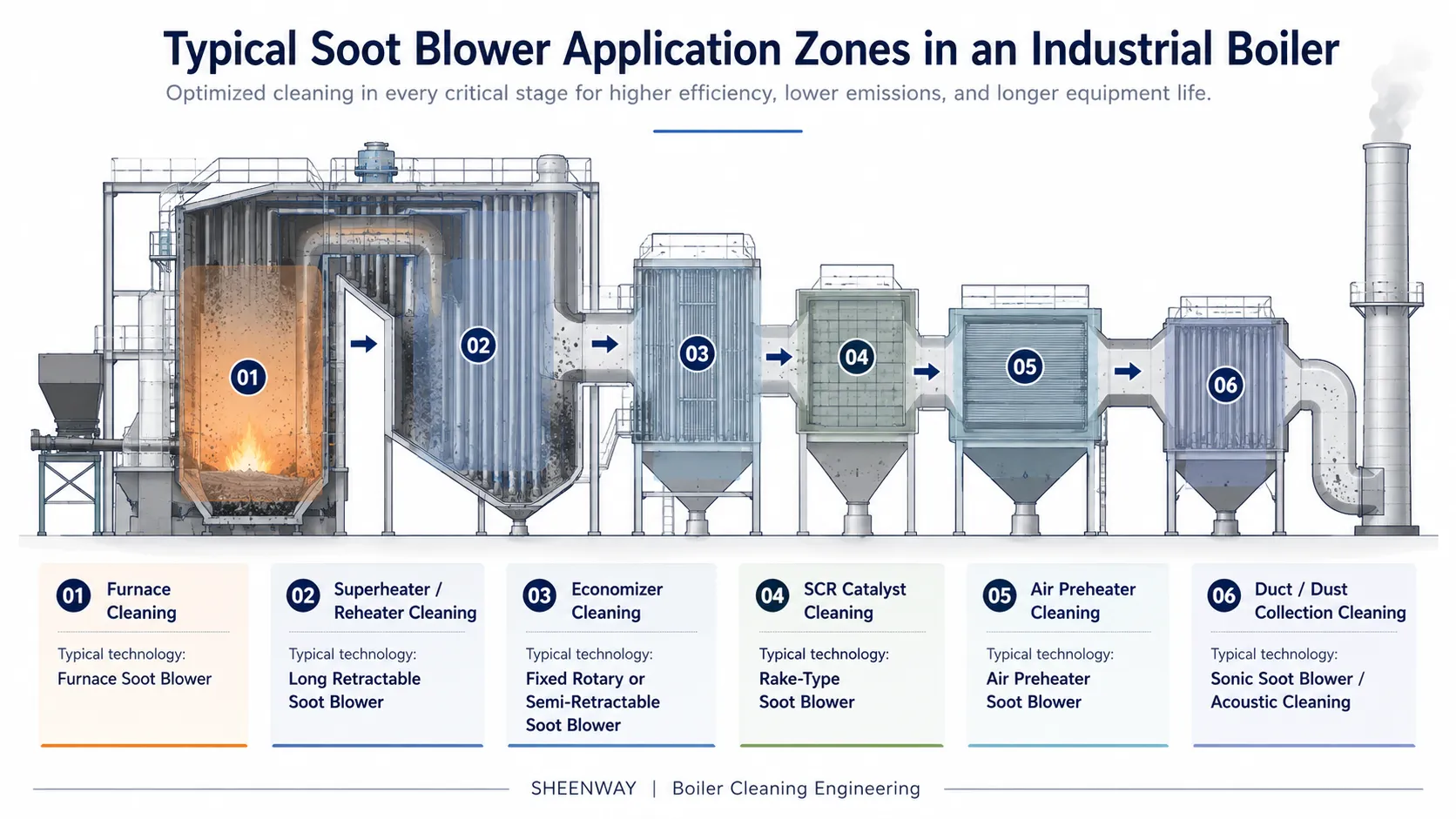
For this reason, modern industrial boilers normally use different soot blowing technologies in different parts of the boiler rather than relying on a single cleaning method.
The boiler-cleaning material you supplied makes the same distinction: furnace soot blowers, long retractable soot blowers, SCR cleaning systems, air-preheater soot blowers and sonic cleaning equipment are used in different regions because the nature of deposits and equipment geometry vary throughout the boiler.
Why Do Boiler Heating Surfaces Need Cleaning?
Ash deposition is a natural consequence of combustion.
Coal, biomass, municipal waste and many industrial fuels contain inorganic components that remain after combustion. Fine particles travel with the flue gas and may deposit on boiler tubes and downstream equipment.
The characteristics of these deposits change considerably as the flue gas moves through the boiler.
Inside the furnace, temperatures may exceed 1,000°C. Under these conditions, some ash components can soften or melt and form hard slag deposits on the furnace water walls.
Further downstream, where gas temperatures are lower, deposits are often more powder-like and may consist primarily of fly ash.
This difference is one of the main reasons different boiler areas require different soot blower designs.
How Does a Conventional Steam Soot Blower Work?
A conventional soot blower normally uses steam or compressed air as the cleaning medium.
The cleaning medium is discharged through one or more specially designed nozzles, producing high-velocity jets directed toward the contaminated heating surface.
Depending on the soot blower design, the lance may rotate, extend into the boiler, remain in a fixed position, or combine rotational and linear movement.
The objective is not simply to generate the highest possible jet force.
Effective soot blowing requires the correct relationship between nozzle geometry, blowing pressure, distance to the heating surface, lance movement and the characteristics of the deposits being removed.
Excessively weak cleaning may leave deposits in place, while excessive or poorly directed blowing energy may increase unnecessary mechanical and thermal stress on boiler tubes.
Furnace Soot Blowers
Furnace soot blowers are typically installed around the furnace walls and are used primarily for cleaning ash and slag deposits from water-wall surfaces.
A furnace soot blower advances its nozzle into the furnace to the required position and then performs a controlled rotary cleaning cycle.
Because furnace deposits can be relatively hard, the blowing arc, number of rotations and blowing pressure may be adjusted according to the actual slagging characteristics and cleaning requirements.
SHEENWAY's current product documentation specifies furnace soot blowers specifically for cleaning boiler water walls and allows blowing parameters to be adjusted according to deposit conditions.
Long Retractable Soot Blowers
Long retractable soot blowers are commonly used for convective heating surfaces such as superheaters, reheaters and economizers.
Unlike a furnace soot blower that operates close to the boiler wall, a long retractable soot blower must reach deep into tube-bank areas.
During operation, the lance tube travels into and out of the boiler while rotating. The nozzle jets therefore follow a controlled cleaning path through the heating-surface area.
Long retractable designs are particularly useful where a large cleaning radius and deep penetration into boiler tube banks are required.
The final stroke, travel speed, rotational speed, nozzle diameter, steam pressure and flow should not be treated as fixed values. They are selected according to boiler gas temperature, fuel, ash characteristics and available blowing-medium conditions.
Semi-Retractable Soot Blowers
A semi-retractable soot blower (half-retractable soot blower) is a variation of the long retractable design.
Part of the lance tube remains inside the boiler during standby, which reduces the external travel distance required by the equipment.
This configuration can be useful in economizers, tubular air preheaters, waste heat boilers and other lower-temperature sections where available maintenance-platform space is limited.
Because several nozzle groups can be positioned along the lance, the effective cleaning area may be considerably larger than the mechanical travel of the soot blower itself.
Fixed Rotary Soot Blowers
Fixed rotary soot blowers are used where a full retractable lance is unnecessary.
The blowing tube remains in position and rotates during the cleaning cycle. A valve supplies steam or compressed air to the lance, while the rotational mechanism determines the cleaning trajectory.
These units are frequently used in relatively lower-temperature boiler sections and other locations where fixed-position cleaning can provide sufficient coverage.
Air Preheater Soot Blowers
Rotary air preheaters present a different cleaning problem because the heat-transfer elements themselves rotate.
An air-preheater soot blower therefore typically moves the lance linearly while the air-preheater rotor turns.
The combined movements allow the nozzle jets to form a spiral cleaning trajectory across the heat-transfer elements.
Nozzle spacing and configuration must be selected according to the geometry of the specific air preheater rather than treated as a universal arrangement.
Rake-Type Soot Blowers for SCR Systems
SCR catalyst surfaces require particularly controlled cleaning.
The catalyst contains narrow gas passages that can become blocked by fly ash and other deposits, but the catalyst structure may also be vulnerable to excessive mechanical impact.
Rake-type soot blowers therefore use a specialized lance and nozzle arrangement to direct the cleaning medium toward the catalyst channels.
The purpose is to achieve targeted cleaning in a geometry where a conventional rotating long retractable soot blower may not provide the required blowing direction.
Sonic Soot Blowers and Acoustic Cleaning
Not all boiler cleaning systems depend on direct steam-jet impact.
A Sonic Soot Blower uses compressed air to generate high-energy sound waves. These pressure fluctuations cause deposited particles to vibrate, loosen and separate from surrounding surfaces.
The released particles can then fall by gravity or be carried away by the gas flow.
Acoustic cleaning is a non-contact method and can be used in applications including boiler tube banks, heat exchangers, SCR reactors, electrostatic precipitators and hoppers.
Frequency selection is important. Lower-frequency sound generally travels farther, but equipment geometry, installation distance and structural natural frequencies must also be considered to avoid undesirable resonance.
Pressure-Wave Cleaning Is a Different Technology
Pressure-wave cleaning should not be confused with a Sonic Soot Blower.
Systems such as the SHEENWAY SW-PWCS generate short, high-energy pressure pulses through controlled combustion.
The pressure wave can propagate through the target area and around obstacles, helping reach surfaces that may be difficult to clean with a directional jet.
This makes pressure-wave cleaning another option for applications involving stubborn deposits or complex internal geometries, but it belongs to a different technology family from acoustic cleaning.
How Do Engineers Select the Right Soot Blower?
There is no single soot blower that is ideal for every boiler section.
Selection should consider the boiler geometry, heating-surface arrangement, flue-gas temperature, fuel composition, ash characteristics, deposit strength, available steam or compressed-air conditions, installation space and maintenance requirements.
For example, hard furnace slag may require a fundamentally different cleaning strategy from loose economizer fly ash.
Similarly, an SCR catalyst, a rotary air preheater and a deep superheater tube bank present very different mechanical and cleaning requirements.
The correct approach is therefore to design a soot blowing system around the operating conditions of the boiler rather than simply selecting equipment by model number.
A Soot Blowing System Is More Than a Soot Blower
The cleaning device itself is only one part of the system.
Steam quality, piping design, condensate drainage, wall sealing, electrical controls, travel limits, blowing sequence and maintenance access can all affect long-term performance.
A well-selected soot blower operating with unsuitable steam conditions or poor drainage may still produce inconsistent cleaning results.
This is why boiler soot blowing should be considered as a complete engineering system rather than a collection of individual machines.
Conclusion
Soot blowers are essential components of many industrial boiler cleaning systems, but different boiler zones require different cleaning technologies.
Furnace soot blowers address water-wall slagging. Long retractable soot blowers clean deep convective tube banks. Semi-retractable and fixed rotary designs solve specific space and geometry problems. Air-preheater and rake-type soot blowers are engineered for specialized equipment, while acoustic and pressure-wave cleaning provide alternative mechanisms for applications where direct steam-jet cleaning may not be ideal.
Understanding the deposit, boiler geometry and operating environment is therefore the first step toward choosing an effective soot blowing strategy.
For boiler operators planning a new soot blowing system or replacing existing equipment, SHEENWAY can evaluate the existing boiler configuration, operating conditions and cleaning requirements to develop a suitable technical solution.